Wednesday, December 6, 2017

Maximum Efficiency and Power Transfer Theorem


Maximum Power Transfer Theorem

The condition of maximum power transfer does not result in maximum Efficiency, they both are totally different theorems with different conditions.

If we define the efficiency η as the ratio of power dissipated by the load to power developed by the source, then it is straightforward to calculate from the above circuit diagram that


Consider three particular cases:
  • If , then 
  • If  or  then 
  • If , then 

The efficiency is equal or less than 50% when maximum power transfer is achieved, but approaches 100% as the load resistance approaches infinity, though the total power level tends towards zero.
Efficiency also approaches 100% if the source resistance approaches zero, and 0% if the load resistance approaches zero. In the latter case, all the power is consumed inside the source (unless the source also has no resistance), so the power dissipated in a short circuit is zero.

The mathematical proof explains the theorem clearly.

Circuit diagram

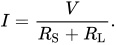
In the diagram opposite, power is being transferred from the source, with voltage V and fixed source resistance RS, to a load with resistance RL, resulting in a current I. By Ohm's law, I is simply the source voltage divided by the total circuit resistance:

The power PL dissipated in the load is the square of the current multiplied by the resistance:

The value of RL for which this expression is a maximum could be calculated by differentiating it, but it is easier to calculate the value of RL for which the denominator is a minimum. The result will be the same in either case.


 Differentiating the denominator with respect to RL:


For a maximum or minimum, the first derivative is zero, so

or

In practical resistive circuits, RS and RL are both positive, so the positive sign in the above is the correct solution.

To find out whether this solution is a minimum or a maximum, the denominator expression is differentiated again:


This is always positive for positive values of  and , showing that the denominator is a minimum, and the power is therefore a maximum, when


Thursday, September 1, 2016

WORM HOLES

WORM HOLES


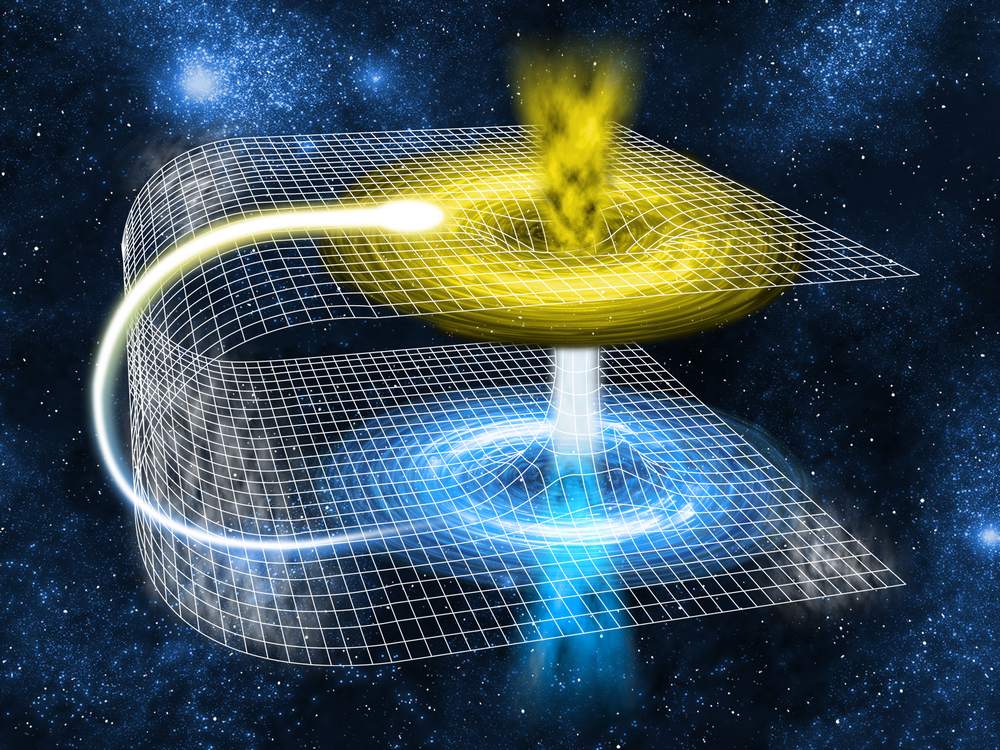
A wormhole is a theoretical passage through space-time that could create shortcuts for long journeys across the universe. Wormholes are predicted by the theory of general relativity. But be wary: wormholes bring with them the dangers of sudden collapse, high radiation and dangerous contact with exotic matter.

In 1935, physicists Albert Einstein and Nathan Rosen used the theory of general relativity to propose the existence of "bridges" through space-time. These paths, called Einstein-Rosen bridges or wormholes, connect two different points in space-time, theoretically creating a shortcut that could reduce travel time and distance. 
Einstein's theory of general relativity mathematically predicts the existence of wormholes, but none have been discovered to date. A negative mass wormhole might be spotted by the way its gravity affects light that passes by.
Certain solutions of general relativity allow for the existence of wormholes where the mouth of each is a black hole. However, a naturally occurring black hole, formed by the collapse of a dying star, does not by itself create a wormhole.
Science fiction is filled with tales of traveling through wormholes. But the reality of such travel is more complicated, and not just because we've yet to spot one.
The first problem is size. Primordial wormholes are predicted to exist on microscopic levels, about 10–33 centimeters. However, as the universe expands, it is possible that some may have been stretched to larger sizes.
Another problem comes from stability. The predicted wormholes would be useless for travel because they collapse quickly. But more recent research found that a wormhole containing "exotic" matter could stay open and unchanging for longer periods of time.
Exotic matter, which should not be confused with dark matter or antimatter, contains negative energy density and a large negative pressure. Such matter has only been seen in the behavior of certain vacuum states as part of quantum field theory.
If a wormhole contained sufficient exotic matter, whether naturally occurring or artificially added, it could theoretically be used as a method of sending information or travelers through space.
"A wormhole is not really a means of going back in time, it's a short cut, so that something that was far away is much closer," NASA's Eric Christian wrote.
Although adding exotic matter to a wormhole might stabilize it to the point that human passengers could travel safely through it, there is still the possibility that the addition of "regular" matter would be sufficient to destabilize the portal.
Today's technology is insufficient to enlarge or stabilize wormholes, even if they could be found. However, scientists continue to explore the concept as a method of space travel with the hope that technology will eventually be able to utilize them.

Wednesday, August 24, 2016

CLASSICAL MECHANICS

animation of orbital velocity and centripetal acceleration

CLASSICAL MECHANICS


Classical mechanics describes the motion of macroscopic objects, from projectiles to parts of machinery, as well as astronomical objects, such as spacecraftplanetsstars, and galaxies. Within classical mechanics are fields of study that describe the behavior of solidsliquids and gases and other specific sub-topics. Classical mechanics also provides extremely accurate results as long as the domain of study is restricted to large objects and the speeds involved do not approach the speed of light. When the objects being examined are sufficiently small, it becomes necessary to introduce the other major sub-field of mechanics, quantum mechanics, which adjusts the laws of physics of macroscopic objects for the atomic nature of matter by including the wave–particle duality of atoms and molecules. When both quantum mechanics and classical mechanics cannot apply, such as at the quantum level with high speeds, quantum field theory (QFT) becomes applicable.The earliest development of classical mechanics is often referred to as Newtonian mechanics, and is associated with the physical concepts employed by and the mathematical methods invented by Newton, Leibniz, and others.


  • NEWTON'S FIRST LAW OF MOTION:  A body at rest will remain at rest, and a body in motion will remain in motion unless it is acted upon by an external force.

  • NEWTONS'S SECOND LAW OF MOTIONThe net force acting on an object is equal to the mass of that object times its acceleration.
  • NEWTON'S SECOND LAW OF MOTIONFor every action, there is an equal and opposite reaction.
  • NEWTONS LAW OF UNIVERSAL GRAVITATIONThe pull of gravity between two objects will be proportional to the masses of the objects and inversely proportional to the square of the distance between their centers of mass.
  • LAW OF CONSERVATION OF ENERGYEnergy cannot be created nor destroyed, and instead changes from one form to another; for example, mechanical energy turning into heat energy.
  • LAW OF CONSERVATION OF MOMENTUMIn the absence of external forces such as friction, when objects collide, the total momentum before the collision is the same as the total momentum after the collision.
  • BERNOULLI'S PRINCIPLEWithin a continuous streamline of fluid flow, a fluid's hydrostatic pressure will balance in contrast to its speed and elevation.
classical mechanics lecture 1

classical mechanics lecture 2


classical mechanics lecture 3


classical mechanics lecture 4


Sunday, August 21, 2016

PARTICLES OF GRAVITY

PARTICLES OF GRAVITY


It may be possible to draw energy from a vacuum using gravity, a theoretical physicist says.
If researchers succeed in showing that this can happen, it could prove the long-postulated existence of the graviton, the particle of gravity, and perhaps bring scientists one step closer to developing a "theory of everything" that can explain how the universe works from its smallest to largest scales.The new research specifically found that it might be possible to show that gravitons do exist by using superconducting plates to measure a phenomenon with the esoteric name of "the gravitational Casimir effect".

Friday, May 13, 2016

SUPERSONIC FLIGHT

A speeding bullet

SUPERSONIC FLIGHT


Supersonic flight is one of the four speeds of flight. Objects moving at supersonic speeds are going faster than the speed of sound.
The speed of sound is about 768 miles per hour at sea level. That is about four times faster than a racecar.
Supersonic includes speeds up to five times faster than the speed of sound!
The first person to fly an aircraft faster than the speed of sound was Capt. Charles E. "Chuck" Yeager.                                                                                                                                                       A bullet fired from a gun travels at supersonic speeds. This                                                                                                                           picture shows a bullet and the air flowing around it. The bullet is                                                                                                                   traveling at 1.5 times the speed of sound.
              

What Flies at Supersonic Speeds?


A bullet fired from a gun flies at supersonic speeds. Some military aircraft also fly this fast. The space shuttle flies at supersonic speeds during parts of its mission.

The most famous airplane to fly passengers at supersonic speeds was called the Concorde. The Concorde's fastest speed was more than twice the speed of sound. It could fly people from London, England, to New York in less than 3 1/2 hours. A regular airplane would take twice that long! The Concorde stopped flying in 2003.

Sunday, April 17, 2016

MATTER, ANTIMATTER & LHC

MATTER, ANTIMATTER AND LHC

Every type of particle has a corresponding antiparticle, for example;
  • the positron is the antiparticle of the electron
  • the antiproton is the antiparticle of the proton
  • the antineutron is the antiparticle of the neutron
  • the antineutrino is the antiparticle of the neutrino
The positron for example has the same mass as an electron but it has a positive (+) charge whereas and electron has a negative (-) charge.
particle table new

pair production and annihilation

When a particle and its antiparticle meet each other they annihilate each other. Their mass is converted into energy in the form of photons.
This is an example of mass being converted into energy but it can also work the other way around with energy being converted into mass.
High energy photons can produce  a particle and its antiparticle, this is called pair production.

Large Hadron collider is used to collide matter and antimatter.
The Large Hadron Collider (LHC) is the world's largest and most powerful particle colliderthe largest, most complex experimental facility ever built, and the largest single machine in the world.
The LHC's aim is to allow physicists to test the predictions of different theories of particle physicshigh-energy physics and in particular, to further test the properties of the Higgs boson and the large family of new particles predicted by supersymmetric theories, and other unsolved questions of physics, advancing human understanding of physical laws. It contains seven detectors, each designed for certain kinds of research. The proton-proton collision is the primary operation method, but the LHC has also collided protons with lead nuclei for two months in 2013 and used lead–lead collisions for about one month each in 2010, 2011, 2013 and 2015 for other investigations.

HOW LHC WORKS


Thursday, April 14, 2016

DARK MATTER AND AND DARK ENERGY

DARK MATTER AND DARK ENERGY

First, watch this video to get some basic idea

VIDEO 1

WHAT IS DARK MATTER?


Dark matter is a hypothetical substance that is believed by most astronomers to account for around five-sixths of the matter in the universe. Although it has not been directly observed, its existence and properties are inferred from its various gravitational effects: on the motions of visible matter; via gravitational lensing its influence on the universe's large-scale structure, and its effects in the cosmic microwave background. Dark matter is transparent to electromagnetic radiation and/or is so dense and small that it fails to absorb or emit enough radiation to be detectable with current imaging technology.

By fitting a theoretical model of the composition of the Universe to the combined set of cosmological observations, scientists have come up with the composition that we described above, ~68% dark energy, ~27% dark matter, ~5% normal matter.We are much more certain what dark matter is not than we are what it is. First, it is dark, meaning that it is not in the form of stars and planets that we see. Observations show that there is far too little visible matter in the Universe to make up the 27% required by the observations. Second, it is not in the form of dark clouds of normal matter, matter made up of particles called baryons. We know this because we would be able to detect baryonic clouds by their absorption of radiation passing through them. Third, dark matter is not antimatter, because we do not see the unique gamma rays that are produced when antimatter annihilates with matter. Finally, we can rule out large galaxy-sized black holes on the basis of how many gravitational lenses we see. High concentrations of matter bend light passing near them from objects further away, but we do not see enough lensing events to suggest that such objects to make up the required 25% dark matter contribution.


DARK ENERGY


 dark energy is an unknown form of energy which is hypothesized to permeate all of space, tending to accelerate the expansion of the universe. Dark energy is the most accepted hypothesis to explain the observations since the 1990s indicating that the universe is expanding at an accelerating rate.
The existence of dark energy, in whatever form, is needed to reconcile the measured geometry of space with the total amount of matter in the universe. Measurements of cosmic microwave background (CMB) anisotropies indicate that the universe is close to flat. For the shape of the universe to be flat, the mass/energy density of the universe must be equal to the critical density. The total amount of matter in the universe (including baryons and dark matter), as measured from the CMB spectrum, accounts for only about 30% of the critical density. This implies the existence of an additional form of energy to account for the remaining 70%.