Monday, May 13, 2019

FM Modulation


FM Modulation

The block diagram for a basic FM Modulator:

Some times post-amplification is also carried out after the modulation.

Circuit Diagram:

This circuit does not include pre-amplification to make it simple to understand.


Electret Microphone

An electret microphone has two pins which connect to the positive and negative leads of a battery. As shown in the drawing below, one looks at the bottom of the electret microphone. The pad that physically touches the microphone's casing connects to the battery's negative lead.


2N2222A Transistor

The 2N2222A is a very common NPN transistor. The one used here (Jameco #38236) is the metal can type (TO-18 casing). Its three pins are for the transistor's base (B), collector (C) and emitter (E). There is no standard pinout for transistors. As such, request the transistor's spec sheet when ordering it to identify the pinout, or if you own a multimeter with a transistor tester, use it.
The 2N2222A also comes in a black plastic casing (TO-92 style) which you can use if you want. The T0-18 is preferred because the can has a small tab that typically represents the emitter pin.

Make sure you correctly identify the 2N2222A's pinout and correctly wire the base, collector and emitter in the schematic. Often, circuit malfunctions because the pins were mis-wired.

Variable Capacitor

The leads for the variable capacitor do not fit in normal 0.1 inch protoboards. You can dremel-drill into the protoboard to make the leads fit. Alternatively you can solder wire to the leads, but if you do, keep wires as short as possible in order to avoid stray capacitance.

Theory: How does the FM Transmitter Work?


The variable capacitor and your self-made inductor will vibrate at frequencies in the FM radio band (88 to 108 MHz). The electret microphone has a resistance that depends on how loudly you speak into it. This microphone is battery powered and according to the V=IR Ohm's Law, changes in resistance for fixed voltage will result in proportional changes in current. This current feeds into the base of the 2N2222 NPN transistor which is connected to your variable capacitor, inductor and antenna. The net effect is that depending on your variable capacitor's value, your voice will be modulated to transmit at a frequency between 88 and 108 MHz. If a nearby pocket FM radio is tuned to this frequency, you'll be heard when speaking into your transmitter.

The component values in the circuit are derived to better understand how this FM transmitter will work. The underlying math is rather simple and can be found in most undergraduate university physics textbooks.


The specific frequency f generated is now determined by the capacitance C and inductance L measured in Farads and Henry respectively:


Resonant Frequency of a Parallel LC Circuit:

FM radio stations operate on frequencies between 88 and 108 MHz. The variable capacitor and your self-made inductor constitute a parallel LC circuit. It is also called a tank circuit and will vibrate at a resonant frequency which will be picked up your pocket FM radio.
In tank circuits, the underlying physics is that a capacitor stores electrical energy in the electric field between its plates and an inductor stores energy in the magnetic field induced by the coil winding. The mechanical equivalent is the energy balance in a flywheel; angular momentum (kinetic energy) is balanced by the spring (potential energy). Another example is a pendulum where there's a kinetic versus potential energy balance that dictates the period (or frequency) of oscillations.

Given your variable capacitor ranges from 4 to 34 pF, your tank circuit will resonant between 66 and 192 MHz, well within the FM radio range.


FM Circuit with Pre-Amplification:


Wednesday, December 6, 2017

Maximum Efficiency and Power Transfer Theorem


Maximum Power Transfer Theorem

The condition of maximum power transfer does not result in maximum Efficiency, they both are totally different theorems with different conditions.

If we define the efficiency η as the ratio of power dissipated by the load to power developed by the source, then it is straightforward to calculate from the above circuit diagram that


Consider three particular cases:
  • If , then 
  • If  or  then 
  • If , then 

The efficiency is equal or less than 50% when maximum power transfer is achieved, but approaches 100% as the load resistance approaches infinity, though the total power level tends towards zero.
Efficiency also approaches 100% if the source resistance approaches zero, and 0% if the load resistance approaches zero. In the latter case, all the power is consumed inside the source (unless the source also has no resistance), so the power dissipated in a short circuit is zero.

The mathematical proof explains the theorem clearly.

Circuit diagram

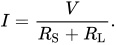
In the diagram opposite, power is being transferred from the source, with voltage V and fixed source resistance RS, to a load with resistance RL, resulting in a current I. By Ohm's law, I is simply the source voltage divided by the total circuit resistance:


The power PL dissipated in the load is the square of the current multiplied by the resistance:

The value of RL for which this expression is a maximum could be calculated by differentiating it, but it is easier to calculate the value of RL for which the denominator is a minimum. The result will be the same in either case.


 Differentiating the denominator with respect to RL:


For a maximum or minimum, the first derivative is zero, so

or

In practical resistive circuits, RS and RL are both positive, so the positive sign in the above is the correct solution.

To find out whether this solution is a minimum or a maximum, the denominator expression is differentiated again:


This is always positive for positive values of  and , showing that the denominator is a minimum, and the power is therefore a maximum, when


Thursday, September 1, 2016

WORM HOLES

WORM HOLES


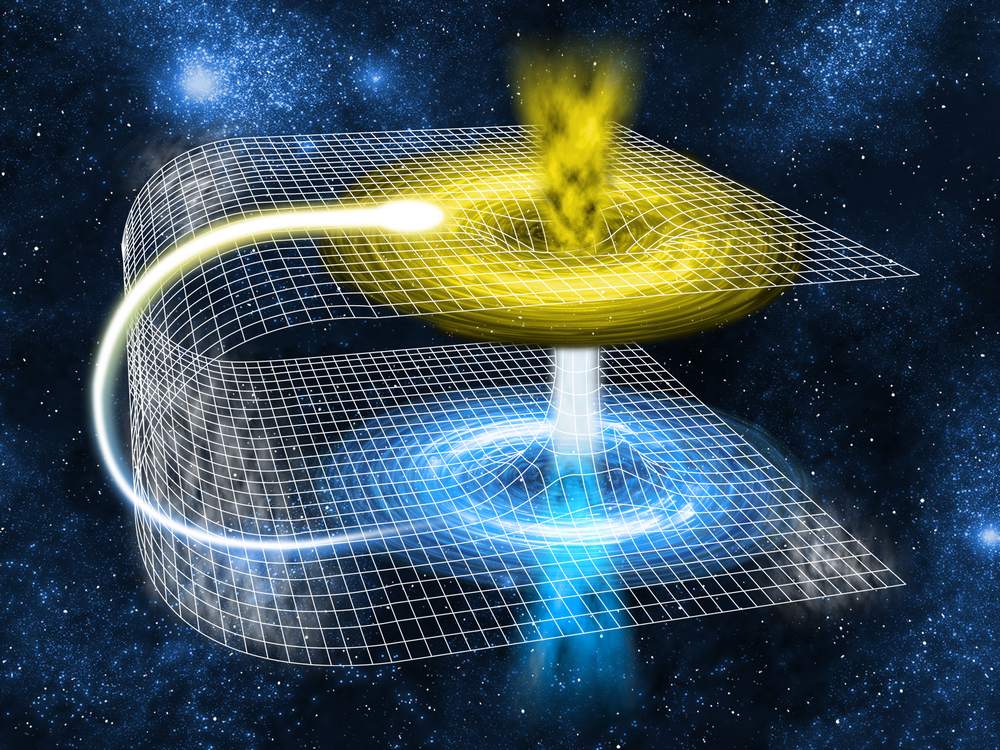
A wormhole is a theoretical passage through space-time that could create shortcuts for long journeys across the universe. Wormholes are predicted by the theory of general relativity. But be wary: wormholes bring with them the dangers of sudden collapse, high radiation and dangerous contact with exotic matter.

In 1935, physicists Albert Einstein and Nathan Rosen used the theory of general relativity to propose the existence of "bridges" through space-time. These paths, called Einstein-Rosen bridges or wormholes, connect two different points in space-time, theoretically creating a shortcut that could reduce travel time and distance. 
Einstein's theory of general relativity mathematically predicts the existence of wormholes, but none have been discovered to date. A negative mass wormhole might be spotted by the way its gravity affects light that passes by.
Certain solutions of general relativity allow for the existence of wormholes where the mouth of each is a black hole. However, a naturally occurring black hole, formed by the collapse of a dying star, does not by itself create a wormhole.
Science fiction is filled with tales of traveling through wormholes. But the reality of such travel is more complicated, and not just because we've yet to spot one.
The first problem is size. Primordial wormholes are predicted to exist on microscopic levels, about 10–33 centimeters. However, as the universe expands, it is possible that some may have been stretched to larger sizes.
Another problem comes from stability. The predicted wormholes would be useless for travel because they collapse quickly. But more recent research found that a wormhole containing "exotic" matter could stay open and unchanging for longer periods of time.
Exotic matter, which should not be confused with dark matter or antimatter, contains negative energy density and a large negative pressure. Such matter has only been seen in the behavior of certain vacuum states as part of quantum field theory.
If a wormhole contained sufficient exotic matter, whether naturally occurring or artificially added, it could theoretically be used as a method of sending information or travelers through space.
"A wormhole is not really a means of going back in time, it's a short cut, so that something that was far away is much closer," NASA's Eric Christian wrote.
Although adding exotic matter to a wormhole might stabilize it to the point that human passengers could travel safely through it, there is still the possibility that the addition of "regular" matter would be sufficient to destabilize the portal.
Today's technology is insufficient to enlarge or stabilize wormholes, even if they could be found. However, scientists continue to explore the concept as a method of space travel with the hope that technology will eventually be able to utilize them.

Wednesday, August 24, 2016

CLASSICAL MECHANICS

animation of orbital velocity and centripetal acceleration

CLASSICAL MECHANICS


Classical mechanics describes the motion of macroscopic objects, from projectiles to parts of machinery, as well as astronomical objects, such as spacecraftplanetsstars, and galaxies. Within classical mechanics are fields of study that describe the behavior of solidsliquids and gases and other specific sub-topics. Classical mechanics also provides extremely accurate results as long as the domain of study is restricted to large objects and the speeds involved do not approach the speed of light. When the objects being examined are sufficiently small, it becomes necessary to introduce the other major sub-field of mechanics, quantum mechanics, which adjusts the laws of physics of macroscopic objects for the atomic nature of matter by including the wave–particle duality of atoms and molecules. When both quantum mechanics and classical mechanics cannot apply, such as at the quantum level with high speeds, quantum field theory (QFT) becomes applicable.The earliest development of classical mechanics is often referred to as Newtonian mechanics, and is associated with the physical concepts employed by and the mathematical methods invented by Newton, Leibniz, and others.


  • NEWTON'S FIRST LAW OF MOTION:  A body at rest will remain at rest, and a body in motion will remain in motion unless it is acted upon by an external force.

  • NEWTONS'S SECOND LAW OF MOTIONThe net force acting on an object is equal to the mass of that object times its acceleration.
  • NEWTON'S SECOND LAW OF MOTIONFor every action, there is an equal and opposite reaction.
  • NEWTONS LAW OF UNIVERSAL GRAVITATIONThe pull of gravity between two objects will be proportional to the masses of the objects and inversely proportional to the square of the distance between their centers of mass.
  • LAW OF CONSERVATION OF ENERGYEnergy cannot be created nor destroyed, and instead changes from one form to another; for example, mechanical energy turning into heat energy.
  • LAW OF CONSERVATION OF MOMENTUMIn the absence of external forces such as friction, when objects collide, the total momentum before the collision is the same as the total momentum after the collision.
  • BERNOULLI'S PRINCIPLEWithin a continuous streamline of fluid flow, a fluid's hydrostatic pressure will balance in contrast to its speed and elevation.
classical mechanics lecture 1

classical mechanics lecture 2


classical mechanics lecture 3


classical mechanics lecture 4


Sunday, August 21, 2016

PARTICLES OF GRAVITY

PARTICLES OF GRAVITY


It may be possible to draw energy from a vacuum using gravity, a theoretical physicist says.
If researchers succeed in showing that this can happen, it could prove the long-postulated existence of the graviton, the particle of gravity, and perhaps bring scientists one step closer to developing a "theory of everything" that can explain how the universe works from its smallest to largest scales.The new research specifically found that it might be possible to show that gravitons do exist by using superconducting plates to measure a phenomenon with the esoteric name of "the gravitational Casimir effect".

Friday, May 13, 2016

SUPERSONIC FLIGHT

A speeding bullet

SUPERSONIC FLIGHT


Supersonic flight is one of the four speeds of flight. Objects moving at supersonic speeds are going faster than the speed of sound.
The speed of sound is about 768 miles per hour at sea level. That is about four times faster than a racecar.
Supersonic includes speeds up to five times faster than the speed of sound!
The first person to fly an aircraft faster than the speed of sound was Capt. Charles E. "Chuck" Yeager.                                                                                                                                                       A bullet fired from a gun travels at supersonic speeds. This                                                                                                                           picture shows a bullet and the air flowing around it. The bullet is                                                                                                                   traveling at 1.5 times the speed of sound.
              

What Flies at Supersonic Speeds?


A bullet fired from a gun flies at supersonic speeds. Some military aircraft also fly this fast. The space shuttle flies at supersonic speeds during parts of its mission.

The most famous airplane to fly passengers at supersonic speeds was called the Concorde. The Concorde's fastest speed was more than twice the speed of sound. It could fly people from London, England, to New York in less than 3 1/2 hours. A regular airplane would take twice that long! The Concorde stopped flying in 2003.

Sunday, April 17, 2016

MATTER, ANTIMATTER & LHC

MATTER, ANTIMATTER AND LHC

Every type of particle has a corresponding antiparticle, for example;
  • the positron is the antiparticle of the electron
  • the antiproton is the antiparticle of the proton
  • the antineutron is the antiparticle of the neutron
  • the antineutrino is the antiparticle of the neutrino
The positron for example has the same mass as an electron but it has a positive (+) charge whereas and electron has a negative (-) charge.
particle table new

pair production and annihilation

When a particle and its antiparticle meet each other they annihilate each other. Their mass is converted into energy in the form of photons.
This is an example of mass being converted into energy but it can also work the other way around with energy being converted into mass.
High energy photons can produce  a particle and its antiparticle, this is called pair production.

Large Hadron collider is used to collide matter and antimatter.
The Large Hadron Collider (LHC) is the world's largest and most powerful particle colliderthe largest, most complex experimental facility ever built, and the largest single machine in the world.
The LHC's aim is to allow physicists to test the predictions of different theories of particle physicshigh-energy physics and in particular, to further test the properties of the Higgs boson and the large family of new particles predicted by supersymmetric theories, and other unsolved questions of physics, advancing human understanding of physical laws. It contains seven detectors, each designed for certain kinds of research. The proton-proton collision is the primary operation method, but the LHC has also collided protons with lead nuclei for two months in 2013 and used lead–lead collisions for about one month each in 2010, 2011, 2013 and 2015 for other investigations.

HOW LHC WORKS


Thursday, April 14, 2016

DARK MATTER AND AND DARK ENERGY

DARK MATTER AND DARK ENERGY

First, watch this video to get some basic idea

VIDEO 1

WHAT IS DARK MATTER?


Dark matter is a hypothetical substance that is believed by most astronomers to account for around five-sixths of the matter in the universe. Although it has not been directly observed, its existence and properties are inferred from its various gravitational effects: on the motions of visible matter; via gravitational lensing its influence on the universe's large-scale structure, and its effects in the cosmic microwave background. Dark matter is transparent to electromagnetic radiation and/or is so dense and small that it fails to absorb or emit enough radiation to be detectable with current imaging technology.

By fitting a theoretical model of the composition of the Universe to the combined set of cosmological observations, scientists have come up with the composition that we described above, ~68% dark energy, ~27% dark matter, ~5% normal matter.We are much more certain what dark matter is not than we are what it is. First, it is dark, meaning that it is not in the form of stars and planets that we see. Observations show that there is far too little visible matter in the Universe to make up the 27% required by the observations. Second, it is not in the form of dark clouds of normal matter, matter made up of particles called baryons. We know this because we would be able to detect baryonic clouds by their absorption of radiation passing through them. Third, dark matter is not antimatter, because we do not see the unique gamma rays that are produced when antimatter annihilates with matter. Finally, we can rule out large galaxy-sized black holes on the basis of how many gravitational lenses we see. High concentrations of matter bend light passing near them from objects further away, but we do not see enough lensing events to suggest that such objects to make up the required 25% dark matter contribution.


DARK ENERGY


 dark energy is an unknown form of energy which is hypothesized to permeate all of space, tending to accelerate the expansion of the universe. Dark energy is the most accepted hypothesis to explain the observations since the 1990s indicating that the universe is expanding at an accelerating rate.
The existence of dark energy, in whatever form, is needed to reconcile the measured geometry of space with the total amount of matter in the universe. Measurements of cosmic microwave background (CMB) anisotropies indicate that the universe is close to flat. For the shape of the universe to be flat, the mass/energy density of the universe must be equal to the critical density. The total amount of matter in the universe (including baryons and dark matter), as measured from the CMB spectrum, accounts for only about 30% of the critical density. This implies the existence of an additional form of energy to account for the remaining 70%.


GRAVITATIONAL WAVES

GRAVITATIONAL WAVES

last week's news from the international science community that gravitational waves, a phenomenon predicted by Einstein 100 years ago.
Image result for gravitational waves explained"On September 14, 2015 at 09:50:45 UTC, the LIGO Hanford, WA, and Livingston, LA, observatories detected the coincident signal GW150914.The initial detection was made by low-latency searches for generic gravitational-wave transients and was reported within three minutes of data acquisition. 

Subsequently, matched-filter analyses that use relativistic models of com- pact binary waveforms recovered GW150914 as the most significant event from each detector for the observations reported here".For the first time, scientists have observed ripples in the fabric of spacetime called gravitational waves, arriving at the earth from a cataclysmic event in the distant universe. This confirms a major prediction of Albert Einstein’s 1915 general theory of relativity and opens an unprecedented new window onto the cosmos.It's the same as when you move your finger over the surface of still water you create waves.

Gravitational waves carry information about their dramatic origins and about the nature of gravity that cannot otherwise be obtained. Physicists have concluded that the detected gravitational waves were produced during the final fraction of a second of the merger of two black holes to produce a single, more massive spinning black hole. This collision of two black holes had been predicted but never observed.
HERE IS THE VIDEO ABOUT HOW GRAVITATIONAL WAVES WERE DISCOVERED
VIDEO ON GRAVITATIONAL WAVES


OPTICES

OPTICS

Refraction is the bending of light rays when passing through a surface between one transparent material and another. It is described by snell's law.
n_1\sin\theta_1 = n_2\sin\theta_2\ .
where θ1 is the angle between the ray and the surface normal in the first medium, θ2 is the angle between the ray and the surface normal in the second medium, and n1 and n2 are the indices of refraction, n = 1 in a vacuum and n > 1 in a transparent substance.
When a beam of light crosses the boundary between a vacuum and another medium, or between two different media, the wavelength of the light changes, but the frequency remains constant. If the beam of light is not orthogonal (or rather normal) to the boundary, the change in wavelength results in a change in the direction of the beam. This change of direction is known as reracetion.

Wednesday, April 13, 2016

WHITE HOLES

WHITE HOLES

In general relativity, a white hole is a hypothetical region of space-time which cannot be entered from the outside, although matter and light can escape from it. In this sense, it is the reverse of a black hole, which can only be entered from the outside and from which matter and light cannot escape.Like black holes, white holes have properties like masscharge, and angular momentum. They attract matter like any other mass, but objects falling towards a white hole would never actually reach the white hole's event horizon (though in the case of the maximally extended Schwarzschild solution, discussed below, the white hole event horizon in the past becomes a black hole event horizon in the future, so any object falling towards it will eventually reach the black hole horizon).

White holes are predicted as part of a solution to the Einstein field equations known as the maximally extended version of the Schwarzschild metric describing an eternal black hole with no charge and no rotation. Here, "maximally extended" refers to the idea that the spacetime should not have any "edges": for any possible trajectory of a free-falling particle (following a geodesic) in the space-time, it should be possible to continue this path arbitrarily far into the particle's future, unless the trajectory hits a gravitational singularity like the one at the center of the black hole's interior. In order to satisfy this requirement, it turns out that in addition to the black hole interior region which particles enter when they fall through the event horizon from the outside, there must be a separate white hole interior region which allows us to extrapolate the trajectories of particles which an outside observer sees rising up away from the event horizon.
There is little evidence of white holes, though. The black hole/white hole appears "eternal" from the perspective of an outside observer, in the sense that particles traveling outward from the white hole interior region can pass the observer at any time, and particles traveling inward which will eventually reach the black hole interior region can also pass the observer at any time.
Just as there are two separate interior regions of the maximally extended spacetime, there are also two separate exterior regions, sometimes called two different "universes", with the second universe allowing us to extrapolate some possible particle trajectories in the two interior regions. This means that the interior black-hole region can contain a mix of particles that fell in from either universe (and thus an observer who fell in from one universe might be able to see light that fell in from the other one), and likewise particles from the interior white-hole region can escape into either universe.

Tuesday, April 12, 2016

BLACK HOLES

Schwarzschild black hole

BLACK HOLES

black hole is a region of space-time exhibiting such strong gravitational effects that nothing—including particles and electromagnetic radiation such as light—can escape from inside it. The theory of general relativity predicts that a sufficiently compact mass can deform spacetime to form a black hole.
The boundary of the region from which no escape is possible is called the event horizon.In short these are objects whose gravitational field is too strong for light to escape.


Simulated view of a black hole in front of 
the Large Magellanic Cloud. Note the 
gravitational lensing effect, which produces
 two enlarged but highly distorted views of 
the Cloud. Across the top, the Milky Way disk
 appears distorted into an arc.

   What happens in spacetime according to General Relativity.A star will curve and distort the spacetime near it, more and more, the more massive and more compact the star is. If a massive star that has burnt up its nuclear fuel, cools and shrinks below a critical size, it will quite literally make a bottomless hole in spacetime, that light can't get out of. Such objects were given the name, black holes, by the American physicist, John Wheeler, who was one of the first to recognize their importance, and the problems they pose. The name caught on quickly.It suggested something dark and mysterious.Although you wouldn't notice anything particular as you fell into a black hole.Instead, you would appear to slow down, and hover just outside. You would get dimmer and dimmer, and redder and redder, until you were effectively lost from sight. As far as the outside world is concerned, you would be lost for ever. Because black holes have no hair, in Wheeler's phrase, one can't tell from the outside what is inside a black hole, apart from its mass and rotation. This means that a black hole contains a lot of information that is hidden from the outside world.But there's a limit to the amount of information, one can pack into a region of space. Information requires energy, and energy has mass, by Einstein's famous equation,  E = m c squared. So if there's too much information in a region of space, it will collapse into a black hole, and the size of the black hole will reflect the amount of information. It is like piling more and more books into a library. Eventually,  the shelves will give way, and  the library will collapse into  a black hole.


IMPORTANT!!!!

As everyone knew, nothing could get out of a black hole. Or so it was thought, but Stephen haukinks discovered that particles can leak out of a black hole. The reason is, that on a very small scale, things are a bit fuzzy. This is summed up in the uncertainty relation, discovered by Werner Heisenberg in 1923, which says that the more precisely you know the position of a particle, the less precisely you can know its speed, and vice versa. This means that if a particle is in a small black hole, you know its position fairly accurately. Its speed therefore will be rather uncertain, and can be more than the speed of light, which would allow the particle to escape from the black hole. The larger the black hole, the less accurately the position of a particle in it is defined, so the more precisely the speed is defined, and the less chance there is that it will be more than the speed of light.
What does this tell us about whether it is possible to fall in a black hole, and come out in another universe. The existence of alternative histories with black holes, suggests this might be possible. The hole would need to be large, and if it was rotating, it might have a passage to another universe.But you couldn't come back to our universe. So, although I'm keen on space flight, I'm not going to try that.